Memories of a former resident 1946-60

We are very grateful to Tony Keating for his contribution to the site. There are several references to him which can be found if you type Keating into the search box. He has kindly provided additional information to his contribution which is published below and you should cross-refer this with the earlier entries

Notes and Memories of Westgate from 1946 – 1960 

Material collected from an interview with Tony Keating (NOTE – Names and details may not be totally accurate due to distant memory!)

Continue reading Memories of a former resident 1946-60
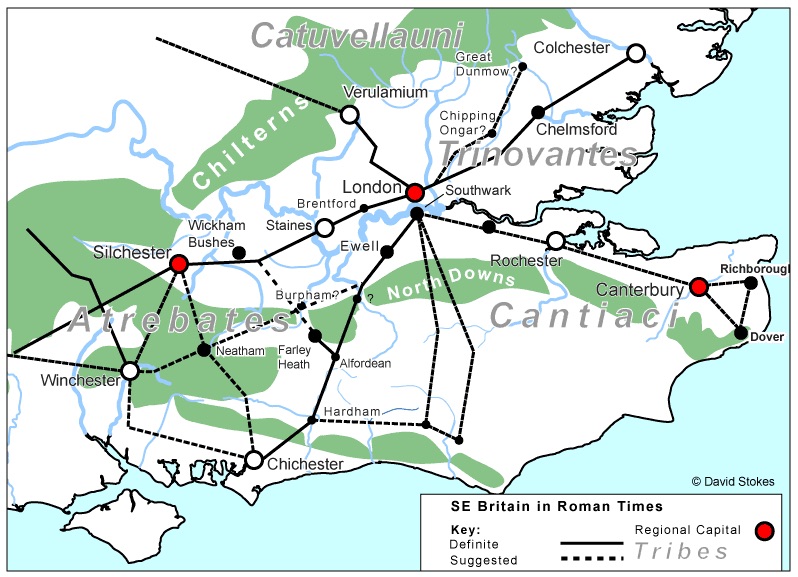
Historic Maps of Westgate

Roman Roads (© David Stokes)

Westgate was not a metalled road in Roman times, although it was an important route to the palace at Fishbourne, onto Bitterne and then Winchester. Note the short road from Chichester to Dell Quay in the south, which came into use when Fishbourne Harbour silted up and the main port for goods and people was moved there.

Continue reading Historic Maps of Westgate

History of 40 Westgate

Formerly number No 34 (1900-1950 numbering)

Known in recent memory as Deering’s sweet shop, this property was a shop well before censuses began in 1841. At that point it was a bakery, already being run by one George Hackett, aged 35, and who describes himself as a baker, a recognised trade of trained artisans. He was still there in the 1851 census: Hackett, George (55) now titled Master baker; and in 1861: Hackett, George (66) Master baker. Still working at age 66.

Continue reading History of 40 Westgate

St Bartholomew’s Church (updated)

THE ORIGINAL ST SEPULCHRE’S CHURCH 

Colin Hicks writes:

Originally on the site of the graveyard at St Bartholomew’s on the corner of Mount Lane and Westgate, stood a church that was probably built in the 12th century. This was round with a circular apse over the altar, a shape associated with the Knights Templar, so that the church became known as the Temple even though it was never associated with those militant monks. New Fishbourne church was probably a chapelry to St Bartholomew at this time. 

Continue reading St Bartholomew’s Church (updated)

Henty Gardens & The Maltings

The Westgate (St Bartholomew’s) suburb contains not just the main street but a collection of side streets that lead off the main road. This is part two of a series designed to present each of these in their own right. You can read about Mount Lane here. We do re-use material from elsewhere that risks being missed since it is scattered through other articles.

The Brewery

Henty Gardens occupies the eastern end of the Henty Brewery site on the north side of Westgate. This is where the original maltings were built in the 1780s, in the Squittery Fields, with the brewery itself more to the west.

Continue reading Henty Gardens & The Maltings

Mount Lane

The Westgate (St Bartholomew’s) suburb contains not just the main street but a collection of side streets that lead off the main road. This is part one of a series designed to present each of these in their own right. You can read about Henty Gardens and The Maltings here. It does re-use some material from earlier articles that risks being missed since it is scattered other postings.

The early history of Mount Lane is hard to identify. It is probable that there has always been a series of tracks leading from the Portsmouth Road into the Westgate Fields and of which the modern Mount Lane is a survivor. Perhaps because a church stood on the corner and the distant memory of a wayside Roman temple persisted.

Continue reading Mount Lane

The West End: who lived in your house?

Due to their fairly recent date, finding information about the properties in the 1930s development of Westgate, and the former industrial sites in the side streets, has proved a challenge. Except for the few that were built in earlier times. The censuses stop at 1921 and we have not trawled the electoral rolls for privacy reasons.

However, we are endeavouring to write up as much of this recent history as is made available. This stops around 1950 to reduce or avoid invading the privacy of current residents.

Continue reading The West End: who lived in your house?

The Theological College

Following extensive research by Dr Brownfield, here is a full description of the history of the Theological College, mostly taken from documents at the WSCC Record Office

The Story

The College was founded by William Otter in July 1838, the first such Diocesan College in England. The first Principal was Charles Marriott, of Oriel College, Oxford. He was a member of the Tractarian Society. The first donation for the college, of £50, was from W. E. Gladstone. 

Continue reading The Theological College

The Westgate Brewery (updated)

The following entry is made up of a number of articles about the Brewery assembled from different sources by Richard Brownfield. [Square bracketed numbers and symbols] refer to the footnotes at the end of this post.

From time to time, we bring in a guest writer to add to the content of our website. We are grateful to local historian Alan H. J. Green for his permission to reprint from this article entitled “The Westgate Brewery”, which originally appeared in the Sussex Industrial Archaeology Society Newsletter 137 of January 2008 [*] 

Continue reading The Westgate Brewery (updated)
error: Content is protected !!