The Roman army, after landing at Fishbourne in AD 43, set up a camp on the site which is now modern Chichester and fortified it with a wooden wall. The town was laid out on a grid with the main streets North and South Street, East and West Street, which crossed in the centre of the town. Where they met the wall there was a gate.
Author: Colin Hicks
Site Admin - Westgate street history, Chichester
The Lavant River
In Sussex dialect a ‘Lavant´ is a winterbourne, which means it only flows during the winter. In C15th documents in the West Sussex Records Office it is also spelt as ‘Louente’ and ‘Lavent’. Most rivers start from a ‘spring’ and gather water from tributaries as they flow downhill.
Westgate Archaeology
This section is edited from articles published by Colin Hicks on the original Westgate Residents Association Website, which were adapted with their permission from an archaeological desk-based assessment prepared by SLR Consulting Ltd on behalf of Chichester College in 2013. Richard Brownfield has very usefully brought these all together, updated and developed them to create a fascinating tour of the history of the western/St Bartholomew’s suburb.
PREHISTORIC WESTGATE
The Westgate Fields
To the south of Westgate were fields and meadows, until the construction of Chichester College in the 1960s. Much of the land belonged to the Dean, and in the 12th century, when he desired to open “a way from his garden to his land and orchards between the wall and the river Lavant”, he had to obtain a licence from the king to make a postern gate. This gate, which can be dated between 1178–1180, is clearly recognisable in the Deanery Garden.
The Parklands Estate
The parklands estate lies to the north of Westgate, bordering the back gardens of the houses on that side. It was built on farmland that had belonged to the church; indeed, the land sold in 1878 for the St Bartholomew’s vicarage, which became number 74, was owned by the Ecclesiastical Commissioners.
History of The Tannery (61-65 Westgate)
Residents
The Undershill family, who turned out to be tanners, are first recorded in the parish in 1526 when they acquire the share of a lease of 20 acres of land with a house. John Undershill is the earliest documented reference to tanning in St. Bartholomew’s when, in 1549, he witnesses the will of John Parker as a tanner.
History of 39-59 Westgate
Known informally as the Tannery Cottages, nos. 39–59 Westgate form a neat row of 10 workman’s cottages.
Originally occupied by tannery workers, these were bought – probably after 1871 – by the Henty family and used for their brewery employees. No information has yet been found of their construction date.
The other branch of the Shippam Family
In our article on nos. 27-39 Westgate, much space has been given to the Shippam grocery business which occupied this site in the 19th century. This was not however the famous Shippam family of the Shippam Pastes. That business was founded by a different member of the family but, confusingly with the same name. This article completes the story of the Shippam family but is not of direct relevance to the history of Westgate.
Shippam’s Pastes
History of 23-25 Westgate
Along with no 25, no 23 is one of a pair of workman’s cottages
Roy Morgan writes:
“The house is recorded as far back as 1379 and is also mentioned 1570. The pair of cottages are recorded in Land tax from 1780 and are shown on Gardner’s map of 1797”.
No. 23 specifically occurs twice elsewhere in the story of this street:
History of 21 Westgate
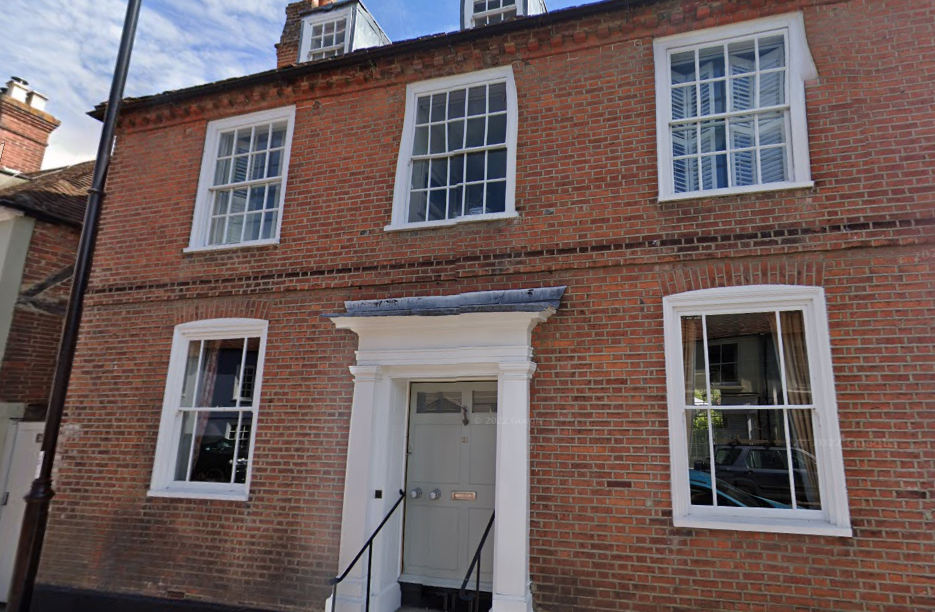
The history of this property has been constructed by Dr Brownfield from the property’s voluminous Schedule of Deeds, by kind permission of the current owners.
For the uninitiated (like me), “Messuage” was a term that referred to a dwelling house along with its adjacent buildings and the land used in connection. A word from late 14c. Anglo-French, it is thought to be a clerical error for “mesnage” (compare modern Fr ménage which means “household”)
Schedule of Deeds