To the east no. 22 has a narrower frontage and wraps itself around the back of no. 24, it then extends into the garden as a single storey building, that appears to have been a stable. Neither has a basement.
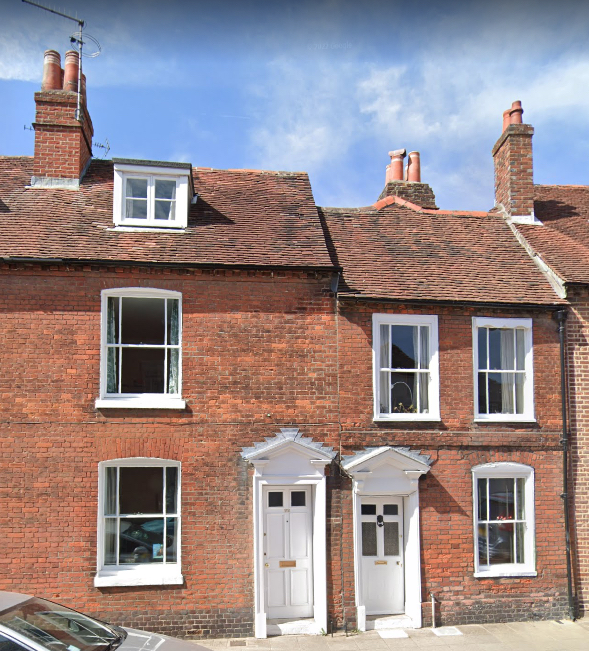
No. 22 is the most ‘Georgianised’ of the two, having wainscot panelling in the hall and six panelled doors to the ground floor. Both houses are now in the same ownership and have been sensitively united not by the usual knocking down of walls but by making discrete openings in the timber framed party walls, so that the separate character of the individual buildings has not been lost.”
Alan Green, by permission
When did this happen?
Looking at the ordnance survey maps, early C20 editions show nos 22 and 24 still to be separate.
Extending census research to the last one available – 1921 – one finds the following: No 22 was being lived in by a widow, Mary Ann Green and her sister, Alice Saunders.
Ten years before that, in 1911, Charles and Mary Ann Green were living there. He was working as a labourer for the Corporation (ie Chichester City Council).
By the time of the wartime directory in Sept 1939, Mary and Albert Abbott are living at no 22, and he is entered as a “heavy worker” at the Henty brewery. Interestingly, the family at no 24 were also brewery workers, in the bottling department.
It is known that the brewery used some of the houses along the north side of the street as offices and housing and perhaps this property was one of them. Brewing on the street lasted until the 1950s, so it is possible that the decision to conjoin the properties was a decision made afterwards, when the brewery was selling off assets.
So we can assert that the houses were separate up until the second world war, which confirms their conjoining was a mid to late C20th decision. Further work undertaken on the electoral rolls may help identify more precisely when. but there is a strong chance that this was in the mid 1990s.