
Originally published in 2016, this article has been considerably improved by the diligent research of Dr Richard Brownfield.
The terrace now numbered 27 to 39 (odds) has had a most complicated history and it has been thought best to present them as an ensemble. The house numbers are therefore printed in bold to assist navigation if you are following the history of a particular property in this row.
Mount Lane
To the west of St Bartholomew’s churchyard is a short lane (now Mount Lane) leading to Westgate Fields, beyond which further development of Westgate took place in the second half of the 18th century.
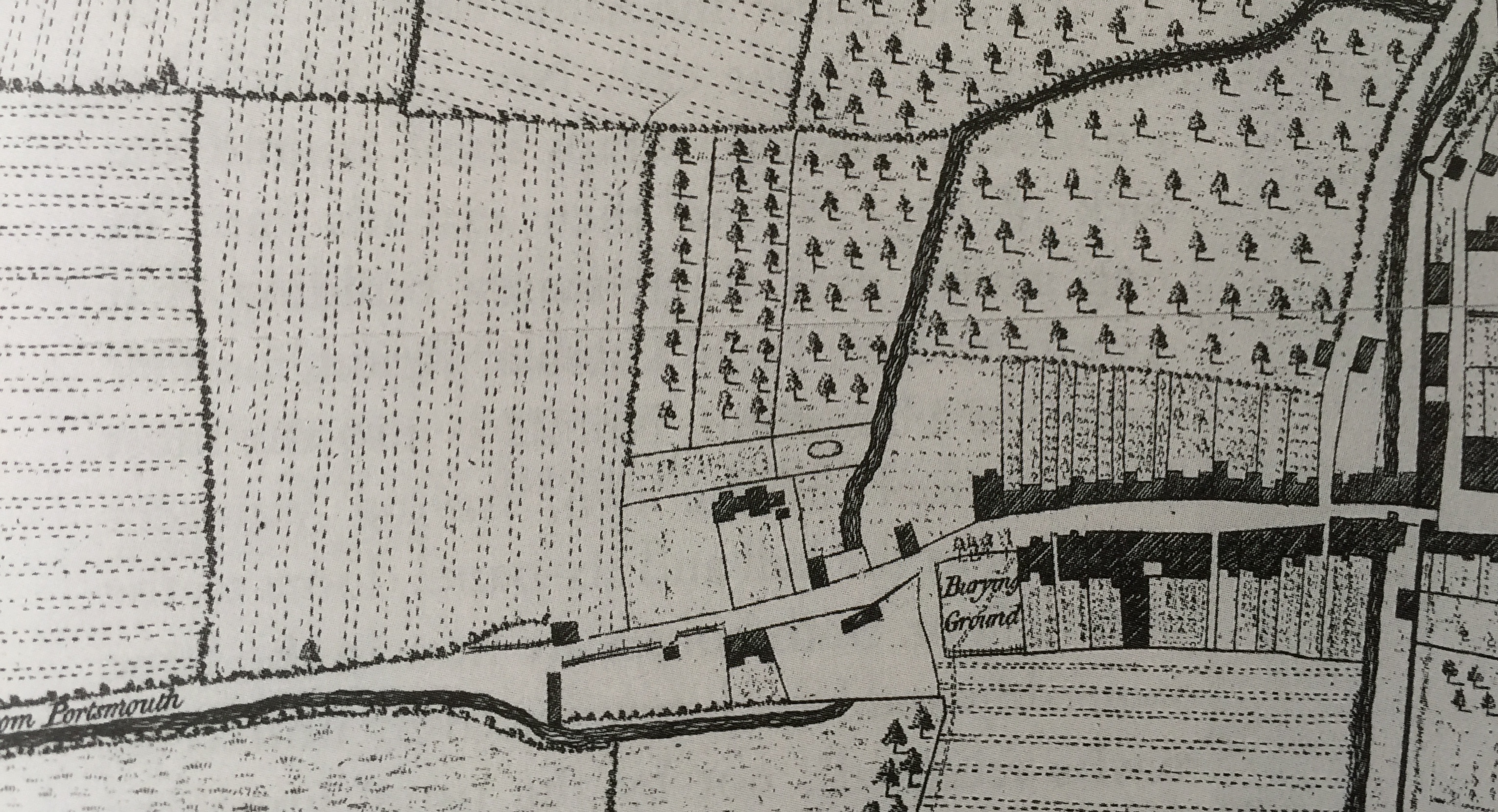
The pair of three-bay houses, Nos. 37 and 39, at the west end are shown on Gardner’s plan [of 1769], but in the gap between them and St Bartholomew’s, it shows only a narrow building at an angle to the road, which it is thought was the original St Sepulchre’s ‘parsonage’, since demolished.
The following single sentence indenture (conveyance) of 9th March 1726 refers to the ‘parsonage’ between the Tannery and the ‘little cartway’ (probably now Mount Lane), where there is at least one watermill, presumably on the Lavant:
“The prebend, parsonage house and garden of St Bartholomew, Chichester, formerly in the tenure of Henry Brown now occupied by Thomas also the parsonage close, formerly in the tenure of Richard Page – all situate outside the Westgate adjoining the “Kings Highway’ on the north, a little cartway belonging to the Dean leading out of the said street through the Lavant course into the parsonage close on the south and a little plot of land formerly Thomas Bennett’s then John Wither’s on the west, the said parsonage close bounded in part by Stephen Vivions’ and John Turners’ and then John Abbot’s, by a garden formerly Edward Finds, by a garden formerly William Tolpetts (3 Westgate) on the north St. Bartholomew’s church yard and garden, in part by a garden formerly, by the Deanery lands on the south, by the lands formerly in the tenure of Edward Underhill (the tannery) now occupied by Thomas Booker on the east, and by lands formerly John Aylwin’s and now Ellis Good’s (once William Harrison’s) on the west, with lease also of all tithes, oblations and emoluments, of the Dean’s mill with appurtenances, of 4 acres of arable and 2 acres of meadow in the west suburbs of Chichester near the mill bounded by 2 meadows formerly in the tenure of Dennis Peel on the north (all these premises being formerly occupied by William Fletcher and Daniel Duffield) together with 1 acre called the Hop-Garden belonging to the Deanery in the south suburbs bounded on the north by the south walls of Chichester and on the west by a plot of ground formerly occupied by John Scott; exception of the tithes from Deanery Farm, the moiety of the toft where the Dean’s mill formerly stood and the moiety of the said mill pond and dashing pool, the term of the lease being for 1 year and the rent of 1 peppercorn.
- Signature: Paul Burrard, and seal.
- Witnesses: George Payne, Robert Wilmer.”
The Shippam Grocers
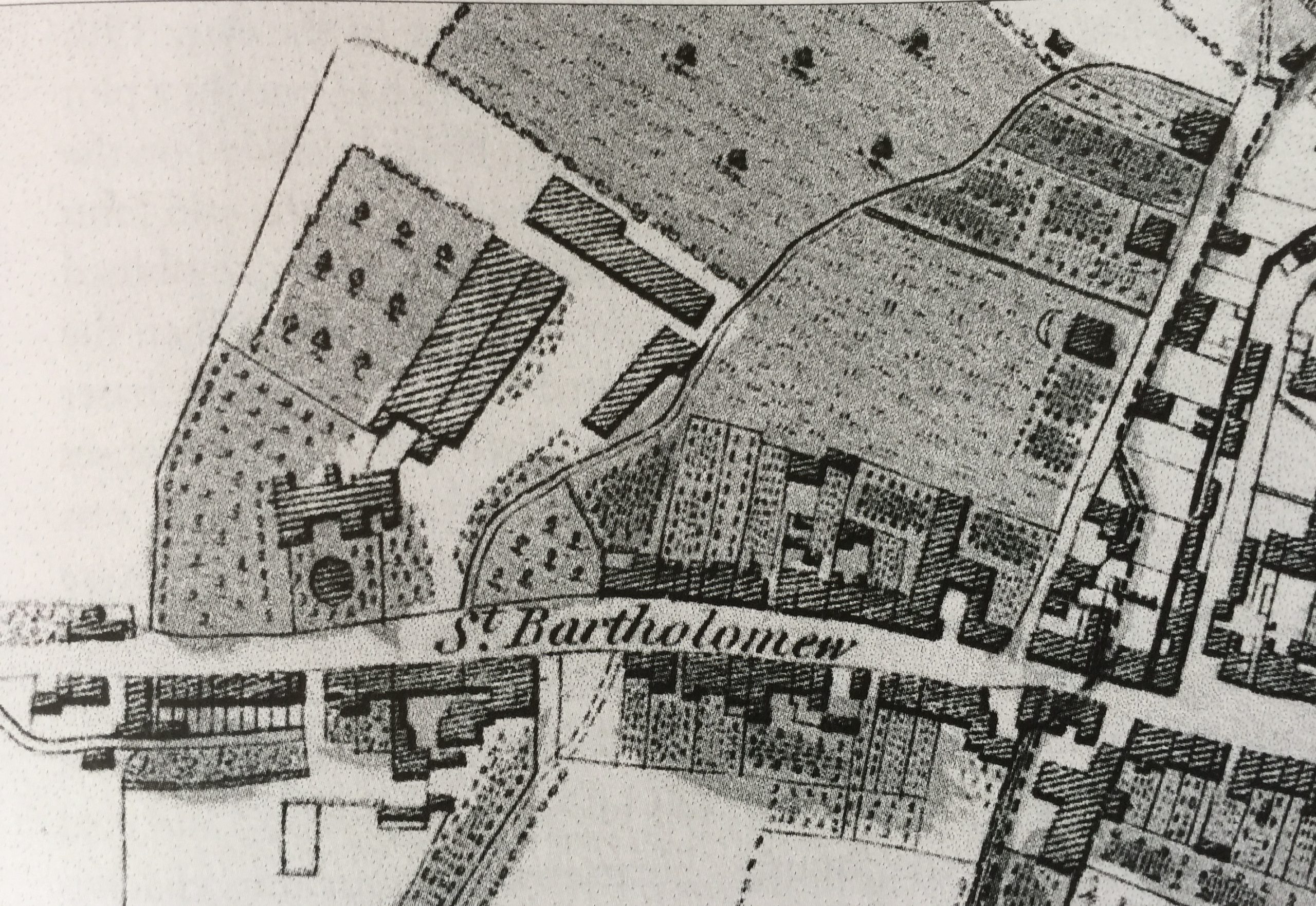
Loader’s map 1812
By 1812, the map by Loader shows the gap had been filled completely by a block of two large buildings, not five houses (27-35 odds) as now exist. Little can be deduced from the fronts of the present houses as they have been altered so much, but high up on a rubblestone wall on the rear of what is now No. 33, is a stone bearing the date of 1789 under the initials ‘JW’*. The current owner however is of the view that the carved stone referred to, because of its odd siting high up at the rear, may well be just a ‘found’ piece of stone and not necessarily original to this building.
A later plan of the Westgate Brewery and its environs, made for Messrs Henty in 1846, indicates the whole of the range of Nos. 27-35 occupied by one building block, which it designates as being ‘Shippams House and Stores’.
The current residents of this stretch of houses know that Shippam’s sausage factory and grocer’s store was situated in these buildings.
Shipston Shippam was living in Boxgrove when his sons were born, Charles in 1761, James 1768, George 1770 and Elias 1777. He was an ex-soldier who had set up a business selling butter, cheese, and bacon in the mid-18th century.
On his death in 1778, his son Charles took over. Charles Shippam married Ann Rock at ‘St Peter the Great’ church in West Street, Chichester on 19th October 1785. Ann’s parish was All Saint’s in the West Pallant, where she had been born in 1766.
The following year (1786), the couple opened a provision shop at modern number 37 Westgate, and lived above. In 1796 Charles bought the freehold and by 1807 they had been able to buy two more houses and a piece of land. They had four sons and six daughters. The sons were William b.1786, Charles b.1792, George b. 1793 and Stephen b.1801. They may have moved into what is now 27 Westgate at about this time.
Necrology
Charles ran the business until his death in 1817, aged 56. This started a period of tragedy for this branch of the family: 5 senior and active members of the family died within 17 years.
Following Charles’ death his widow Ann continued the business under the name of Charles Shippam and Sons with Charles (Jnr.), but he died in 1824, aged 32. Ann added drapery to the business and James’ son Frederick Shippam, her nephew, is listed in an early directory as a draper in East Street. Frederick died in an accident in 1826, and Ann was then no doubt helped by her youngest son Stephen until her death in 1832, aged 66. Stephen died in on January 20th, 1833, aged 32.
The family had an imposing vault built in St Bartholomew’s graveyard and the inscription on the family vault read:
The Family Vault of Charles Shippam who died 1 – 6 – 1817 age 56 | Anne his wife Died Feb 22 1832 Age 66 | Where are interred the remains of 3 sons, 4 daughters, a daughter in law and 2 grandchildren
The memorial has been removed but the graves are presumably still there.
Development of the business site
Following Stephen’s death in 1817 a problem arose as to who would carry on the business, which had been prosperous enough to allow Ann to buy further land in Westgate.
The problem was solved by Ann’s eldest son William (1786-1869) who assumed management of the business, the ownership of which was retained by Ann’s estate. William had been living in Mid-Lavant after the death of his father and ‘had found himself in possession of enough money to settle down in a pleasant little property to enjoy the life of a country squire’ – he had been doing some agricultural sales, much of it with the Duke of Richmond at Goodwood.
By the first national census in 1841, William was living at 27 Westgate with his uncle Elias, who was a younger brother of Charles Snr. William and Elias were both bachelors and two of their three employees were also living in the house.
The 1841 census, which only recorded people’s ages to the nearest five years, shows present at the address that day:
- William Shippam (50) Grocer
- Elias Shippam (60) Grocer
- Edward Burnard (30) Grocer
- Richard Acton (15) Grocer
- Jane Hyde (50) Servant
- Caroline White (20) Servant
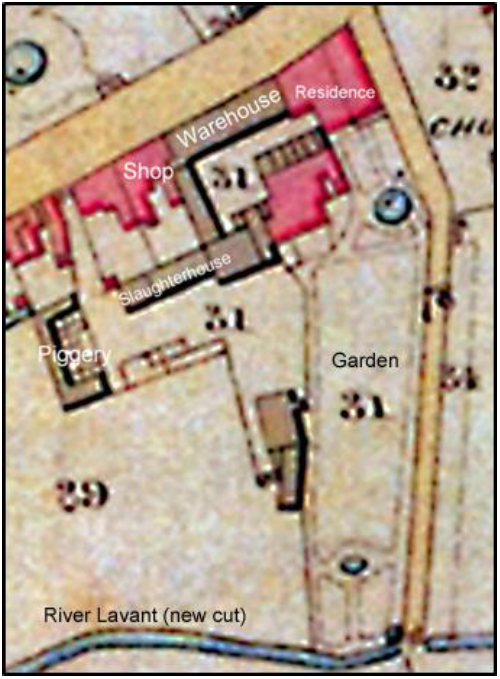
The Shippam property complex in 1846, marked with the number 31, just before it was sold off
The above Tithe map of 1846 shows Shippam’s buildings, stores and a house with a circular water feature in a formal garden at the rear – similar to the one behind no 3 Westgate. It states that this was ‘occupied by William and Elias Shippam, who own three houses with land behind the houses and a piggery’. Their living quarters were clearly made up of two properties conjoined, which may explain why the garden at the rear of no 27 today is still of double width.
Elias died in 1853. William continued to run the Westgate business until 1854/5, after which he moved to Chapel Street. By 1851 Ann Shippam’s estate had started to sell off properties in Westgate, a process which was probably completed by the early 1860s. When William died in 1869 he left £568.
The business appeared to have been declining for some years, possibly due to competition from another flourishing Shippam business in East Street. This had been set up by another Charles Shippam (1828 – 1897) who was the son of George, William’s brother and was destined to become the famous Shippam’s meat paste supplier, even to royalty.
Residential development of the Shippam site on Westgate

By the time of the O.S. map of 1874, there is no sign of the Shippam warehouses. The large property fronting onto Westgate in the middle of the row had been divided into three small houses with gardens, and the two original larger houses to their right, at modern numbers 37 and 39, were restored. Those dwellings are the same as present on the 1812 ‘Loader’ map above, and include the one which had become the Shippam shop.
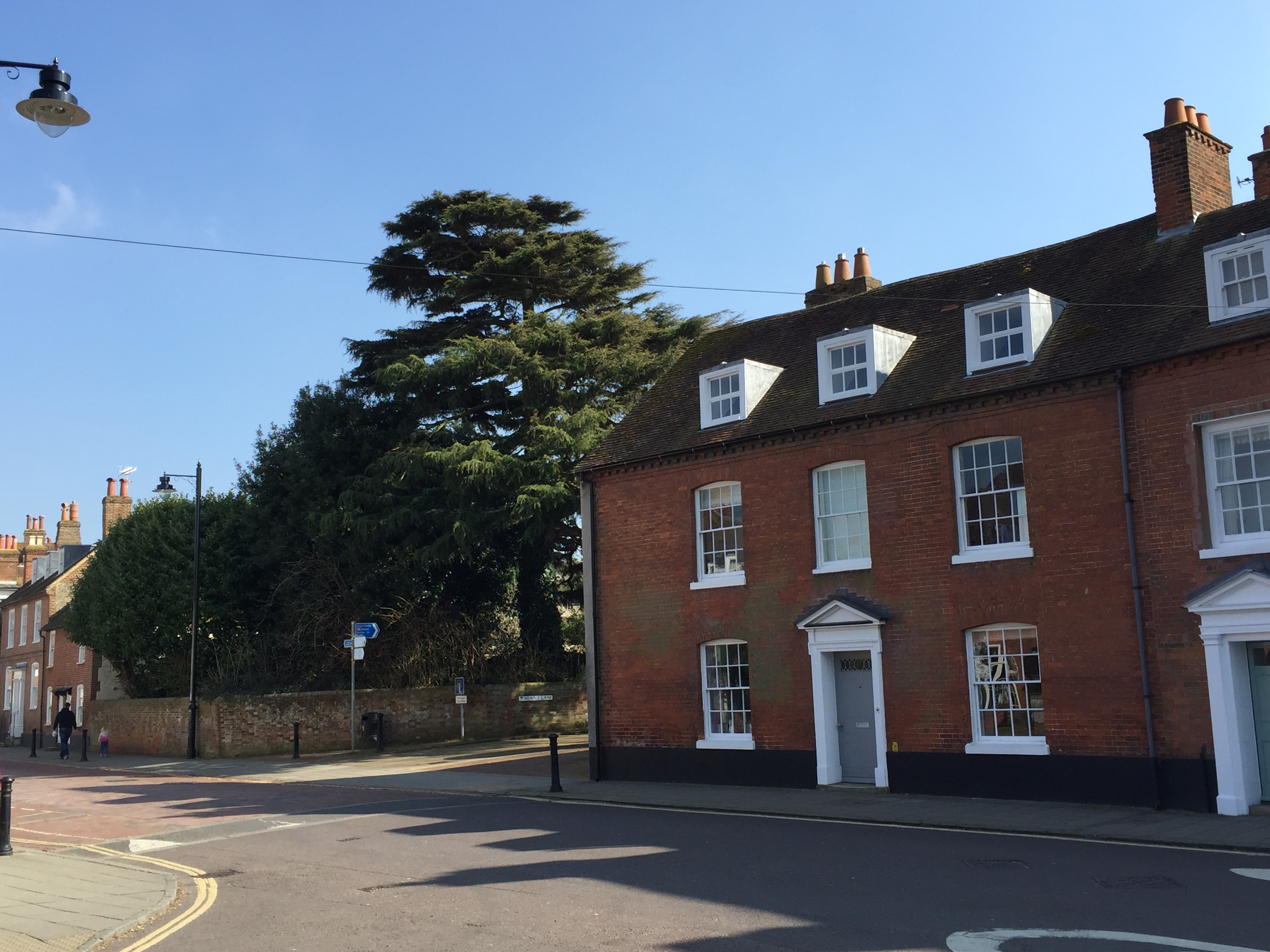
The house which is now no. 29, is still shown by Loader as it was in 1846, sharing a garden with no. 27. (This is the same scenario as no. 17 endures next to no. 19 and is another example of what Alan Green calls the ‘flow’ between property boundaries on Westgate.) This seems to confirm that they continued as a single property for some time, as they certainly were some years later, although today are separate.
Edward Prior the Architect
The great Arts and Craft architect, Edward Schroeder Prior, having moved his family to Chichester in 1907, initially lived in an early 18th-century house at 7 East Pallant. He bought the 18th-century Shippam house on the corner of Mount Lane (current no 27 seen above) with an adjacent warehouse (current no 29 and called Prior House). So during William Shippam’s time, this conjoined property was actually a dwelling (modern 27) with a warehouse (modern 29) attached.
Edward Prior converted the warehouse (no 29) to provide a studio. He also remodelled the back wall of the building, skewing the angle to improve his view of the garden when seated in the back parlour! Interestingly the garden of no 27 was much as today and from 1846 appears to have been landscaped. Up until 2021, it contained a nationally famous Tree of Heaven, which had to be felled due to disease.
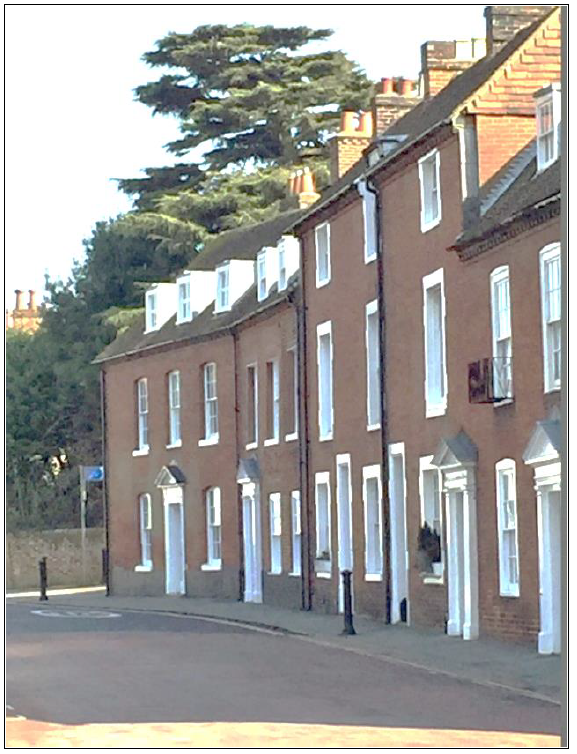
The front of the Shippam Properties as they are today following their conversion to residential use
From the left:
- No. 27 – Residence adjacent to Mount Lane
- No. 29 – ‘Prior House’, originally part of the warehouse altered by Edward Prior
- No. 31 – Warehouse
- No. 33 – Warehouse, with remains of old hoist in the roof
- No. 35 – Warehouse
- No. 37 – Shop (partially visible)
A few hints of the past remain
A door still exists inside No. 37 from a rear flag-stoned room, which was the entrance from the shop into the warehouse at what is now No. 35. It is also thought that the southern boundary wall to Nos. 37 and 39, and integrated since into No.1 St Bartholomew Close, was the wall of the Shippam slaughterhouse. Which became a stable in subsequent times. This was flushed through by the River Lavant, after water had been taken from upstream across the road for the beer-making process. The Tannery also benefitted from this arrangement, but the whole area must have produced strong smells and polluting the harbour water at Fishbourne.
Colin Hicks 2016
Richard Brownfield 2025
I have just discovered your wonderful site and your article about shippam .
My gr gr gr grandfather George sims (born 1800 in Chichester ) was a tanner for shippams in their tannery.
He lived in the westgate .I believe at no 46 and later no 24 ,perhaps they moved because they had 5 children including my gr gr granddad .We believe he kept his ‘tanning trolley ‘
in a cut way down the side of the house?
All their children were baptised in st Bartholomew church and I understand George is buried there as he died in 1867 aged just 67 . I have recently sent off for his death certificate,but would think being a tanner contributed to his early death .I am told urine was used widely in the tanning process ! I would love to know if his grave exists.. is their anyway I can find out ?
His son William was a milkman in westgate in 1861 and his wife a chairwoman .
I hope this has been of interest and look forward to hearing any feed back especially about George’s grave .
Kind regards
Sandie lyons
Hi Sandie, I have just come across your post and am really excited as George Sims was also my gr gr gr grandad aswell!! We are in the process of researching our family tree and have got back as far as George and Mary and now stuck!! We also have his death certificate and further to that we found a newspaper article on how he died, an awful industrial accident at the Tannery!! My gr gr granddad was George (junior), Williams brother!! Is there any way of contacting you so we could put our information together?? Regards Linda Wooldridge
Hi Sandie I have been doing my family tree ,and my aunt Annie Elizabeth Talbot, born 1898-1918 was married to Albert H Shippam 1900! My mother told me she was married to Shippam of Chichester,she died at the age of 21 and buried at Arundel, do you know? About if anything of this side of family,I do have a picture of her,but not Albert,I do believe he remarried,has he was only 17 when he married Annie maybe he had to marry her because she was pregnant ?they were only married 3 months before she died
Kind regards Percy