These notes on the history of this property are by Anne Sparrow. Historic references are in bold to assist further research.
“When we bought No. 68 Westgate, on the deeds it was noted that it was originally called ‘Westgate Close’ [also “Crantock” in Kelly’s directory 1938 – RNB]. The name appeared on the wooden gate that was seldom used, owing to the regular use by our two cars, which were accommodated in an unusual double garage beneath an adjoining flat.
The house seemed to have been commissioned by a naval captain and built in 1938 in the Tudor Arts and Crafts style. There is an impressive weathervane of a Spanish Galleon on the apex of the roof. There is also evidence that at one time the plot extended to Beech Avenue (on the Parklands Estate), which was quite a common feature of the houses on the north side of Westgate.
When we moved in there was a prefabricated garage at the back of the house and a drive leading northwards to the boundary. We later had this garage removed, as we enlarged the footprint of the main garage and flat by building a store, and extending the existing lounge and kitchen with a balcony overlooking the kitchen garden at the back of the house. The first owner only apparently lived in it for about a year, and the next owners were members of the Bartholomew family, who were local Agricultural Seeds Merchants.
We were given photos of its interiors by a lady descendent, which we passed over to the present owners. She also told us of the story that Guy Gibson of Dambusters fame had visited the flat over the garage to meet Jonny Johnstone, famous fighter pilot, who flew from Tangmere.
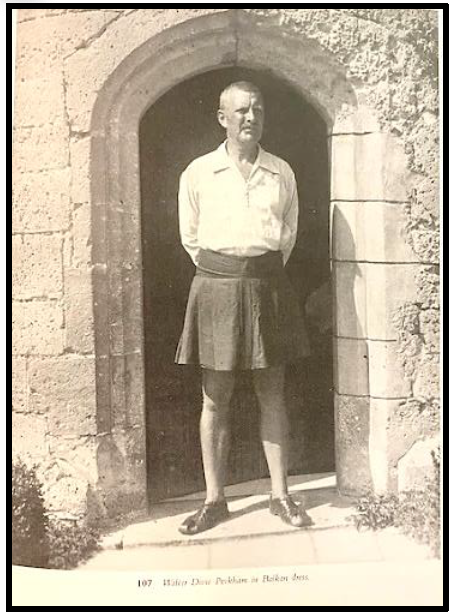
The next owner, probably just after the end of WW2, was a gentleman antiquary, called Walter Peckham; who had previously lived in Rymans at Apuldram. He was obviously wealthy.
Peckham is quoted extensively in the book “Chichester Cathedral — An Historical Survey” edited by Mary Hobbs. Alison McCann tells us that he was a retired Diplomat at the age of 37 (!) who spent his long life researching the cathedral archives. He was an eccentric, who wore Balkan Dress and in his older life became very deaf, so had a hearing aid box taped to his chest. He published numerous works in connection with the Cathedral Archives. His life ended in a nursing home, still working on Cathedral papers.
The house was then bought in about 1973 by a retired American concert pianist, Katherine Langsett. She made considerable changes to the original Tudor Arts and Crafts interior and removed all the original wood panelling which by now had succumbed to woodworm. She also introduced more light into the house by lengthening the windows at the side of the fireplace in the lounge and it may have been she who changed the original lead-lighted windows to clear glass. Not so long after she moved into the house she was found in the garden having suffered a stroke whilst watering the roses.
We moved in on a freezing cold day, 28th January 1979, to a house in which the boiler promptly broke down. But we remained there for 36 happy years and remember it with great fondness. My husband spent many hours in the 2/3-acre garden, and we eventually opened it to visitors for charity. The National Gardens Scheme agreed to include it in their programme, which we did so for a number of years, but then St. Wilfrid’s Hospice asked us to open it for their benefit, to which we readily agreed.
In 2014 due to the pressure of maintaining a large garden which included a pond, small orchard, large herbaceous border, kitchen garden and greenhouse housing an old Black Homburg grape, it was time to move on to a small garden, but not actually a smaller house!”
Richard Brownfield 2025