In Sussex dialect a ‘Lavant´ is a winterbourne, which means it only flows during the winter. In C15th documents in the West Sussex Records Office it is also spelt as ‘Louente’ and ‘Lavent’. Most rivers start from a ‘spring’ and gather water from tributaries as they flow downhill.
The Lavant river is different. Its water seeps up from the bed, when the water table rises to a critical level and the river is deep enough, it starts to drain away to the sea. The Ems nearby has the same characteristics. The Lavant appears first between East Dean and Singleton. However, the water is always there flowing through the gravel beds beneath the surface, which is why there are so many wells in the area. Chichester is largely built over the gravel bed. There is a house in St Martin’s Square with a well with a glass cover, and it is possible to see the height of the water table as it rises and falls.
Nowadays water is extracted from the water table by Portsmouth Water and by farms with bore holes along its course. This results in the table being lower than it once was, when presumably the Lavant used to appear for longer than it does now, otherwise it seems strange that the brewery and the tannery were built on its bank. The river flows down the Lavant Valley, and after Westhampnett Mill there is now a sharp turn to the West towards the City Walls.
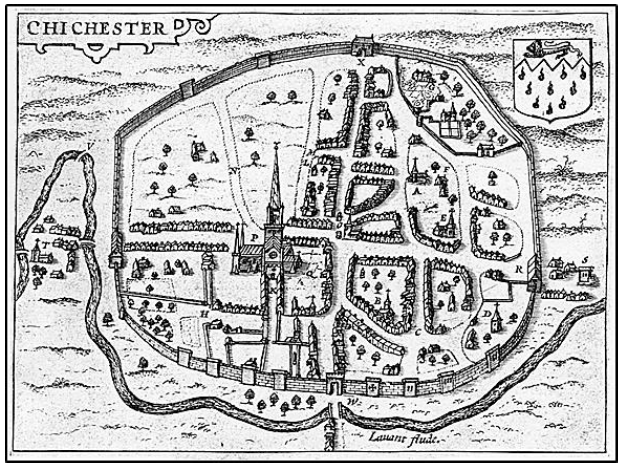
John Speed’s map of Chichester 1610 (Note a church in Westgate with a ‘T’ beside it, which could have stood for ‘Temple’)
The original line of the river was straight on via Pagham Rife to Pagham Harbour. (Following the 1994 floods, this has been revived as an overflow). There is argument about when this was altered, but probably in the 9th century a new course was dug first toward Eastgate then south around the outside of the city walls, all the way round to what was known as Squitry or Scuttery Bridge. Here the lane, now called Orchard Street, crossed the river.
For many years the Lavant was a useful method of sewage disposal. The old English word scittere meant an open sewer. The expression “to have the squitters” is still used occasionally today. This bridge is north of the old West Gate and the river therefore flowed around half the perimeter of the city on its seaward side.
Near the bridge there was a sharp turn to the southwest back towards Westgate. This turn is at the junction with a ditch running south from a meadow by the North Gate known as the Campus (or Campis) and other water also drained down from the north, including from the large pond at the southern end of College Lane – which is why this area so often floods. This was called the Dell Hole (del = valley or chalk pit).
It is possible that the water from the north was the original stream and the Lavant was diverted around the walls to add to the defences, to meet it. The Lavant joined the ditch, and they continued together to Chichester Harbour, which would account for the very strange way the Lavant goes north and then round an acute bend to return south. The river then passed through the brewery, under Westgate and Shippam’s slaughterhouse, along the back of the Tannery Cottages’ gardens, through the Tannery and along the side of the road, down to Chichester Harbour between Fishbourne and Apuldram.
In 1810 the new cut was made, which ran west, from the river at the southwest corner of the city wall, along the back of the gardens of the houses on Westgate until it re-joined the original part of the river, which had turned south after flowing along the edge of the road, beyond the Tannery. The loop to the north was enclosed in a culvert (which is still there under the garden of 1, The Courtyard).
Despite the new cut, water continued to flow in the old bed and a Mr Potter who owned a small dairy with a meadow by the river, just beyond Scuttery bridge, was blamed in the 1880s for the last outbreak of typhoid in Chichester. This was thought to be due to contaminated water from the river being used to cool the milk and for washing buckets. The loop to the north also passed the Brewery, where water was presumably only used for cooling purposes. It was certainly too polluted to make beer. The Brewery had its own 3 wells.
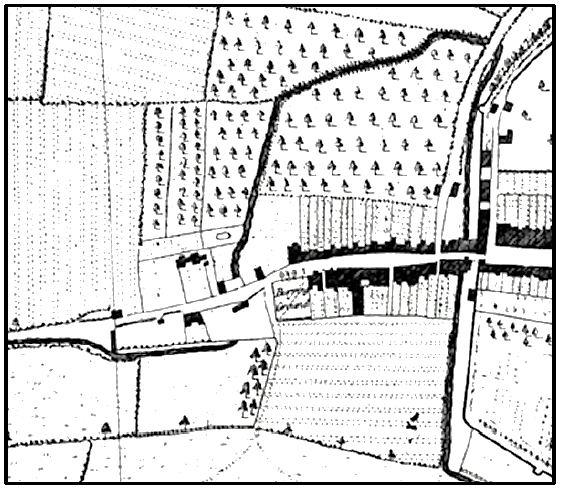
Gardner and Jekyll map of l769, showing the path of the Lavant outside the western city walls turning acutely west at Scuttery Bridge, then south to Westgate and underground.
Is this building a mill? It had been rebuilt by 1846 when the brewery was in place. The building at an angle, south of the road, where the Lavant appears to pass underground across its land before emerging to the south, may have been the old vicarage to St Sepulchre’s church, which was on the “Burrying Ground”. The church was destroyed in 1642, but reports say the vicarage survived.

Lavant branches rejoin (O.S.1875. WSRO)
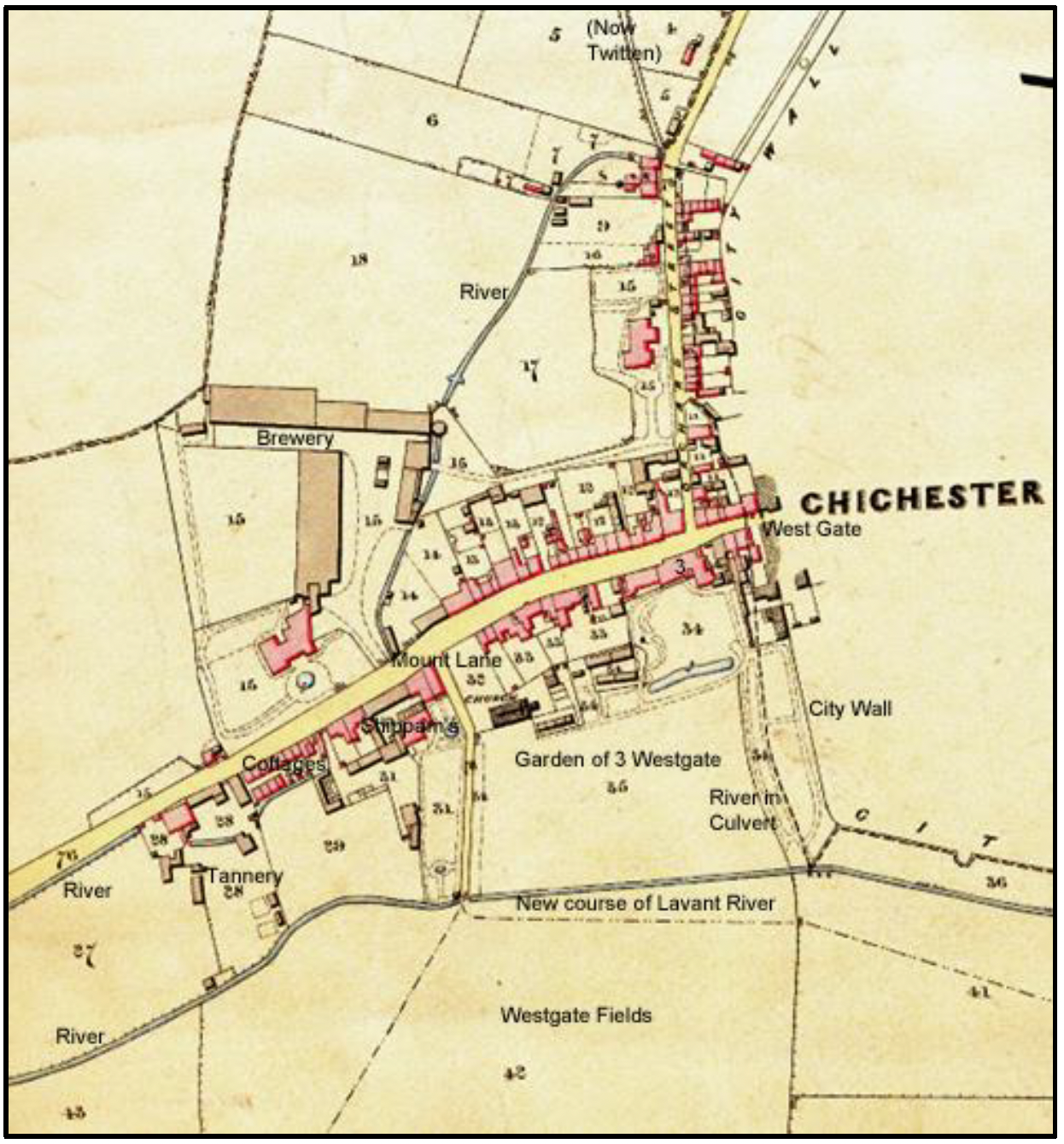
1846 Tithe map showing the new cut at the southwest corner of the city walls, going west. The original arm goes north in a culvert from the junction and is shown dotted. The river emerges again at Scuttery Bridge and turns southwest past Potter’s meadow to the Brewery. It then crosses Westgate and flows under Shippam’s slaughterhouse, the Tannery and along the south side of the road, much of it in culverts. (WSRO)
Richard Brownfield 2025
Sources
- “The Westgate Lavant”. Colin Hicks. April 2017.
- “The River Lavant”. Ken Newbury. Phillimore and Co. 1987.