The Roman army, after landing at Fishbourne in AD 43, set up a camp on the site which is now modern Chichester and fortified it with a wooden wall. The town was laid out on a grid with the main streets North and South Street, East and West Street, which crossed in the centre of the town. Where they met the wall there was a gate.
This town of Noviomagus Reginorum grew inside the wall and, probably in the 2nd or 3rd Century, a stone wall replaced the wood. This has been refaced many times over the ages and none of the original roman wall is visible, but it is probable that the position of the walls has remained largely unchanged.
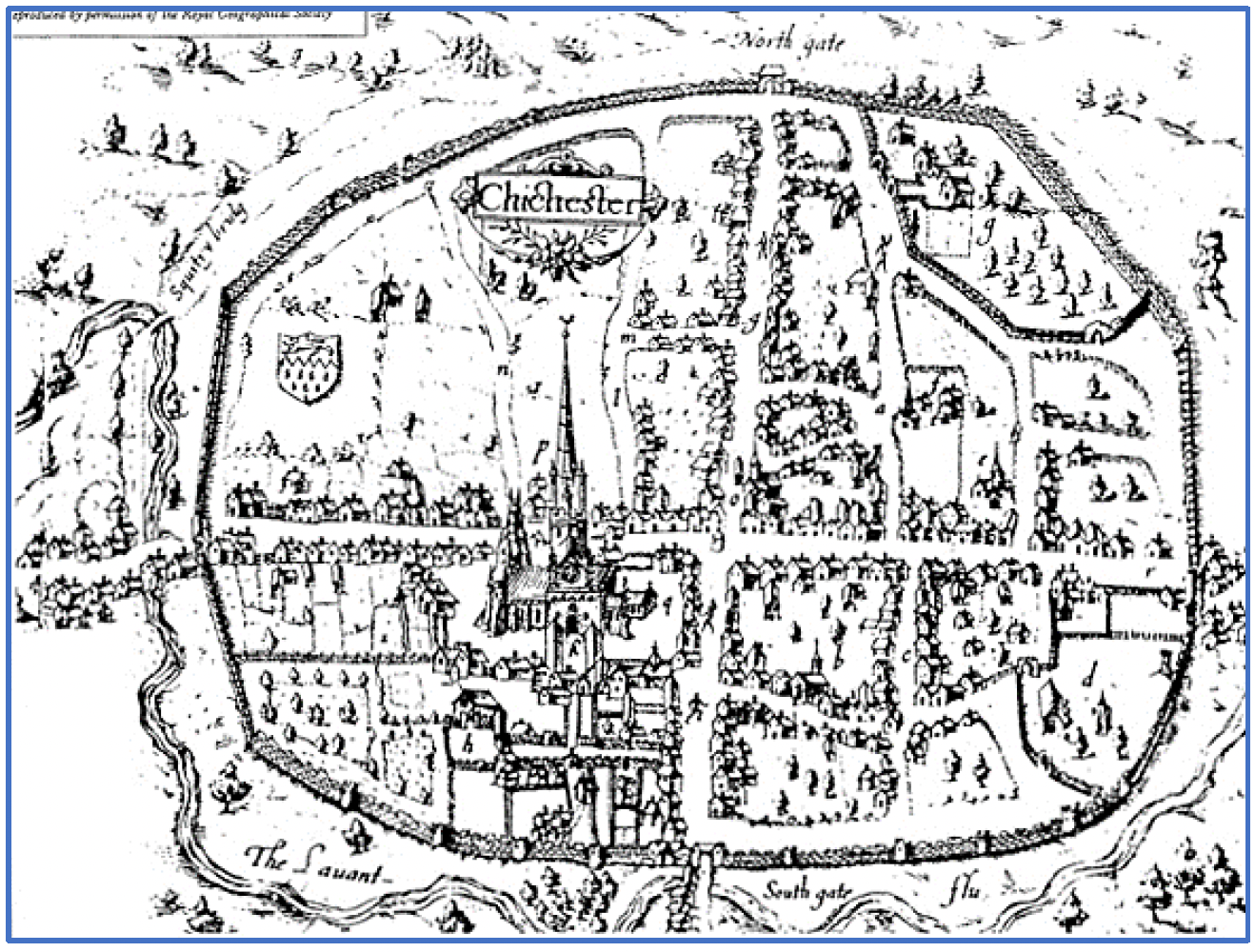
John Norden’s map of 1595
The Saxons, under Alfred the Great, developed Cissa Ceaster (Cisscester or Cicestre modern Chichester) into one of his largest burghs (fortified towns), making full use of the Roman wall. This was just as well since, in 894, the Danes attacked Chichester and the surrounding area but were successfully defeated, emphasising the strength of this fortified town.
The duty of keeping the wall intact was recognised in the 12th century. For when the Dean desired to open a way from his garden to his land and orchards between the wall and the river Lavant, he had to obtain a licence from the king to make a postern gate. This gate, which can be dated between 1178–1180, is clearly recognisable in the Deanery Garden.
In 1260 the limits of the city were defined. It was then stated that the ‘King of the Romans’ (Richard, Earl of Cornwall) held no control beyond 30ft outside the walls, that is, to the ‘width of the great ditch.’ “All tenements beyond the ditch were outside his liberty and jurisdiction, and the bailiffs of the city could not exercise their office there.”
The history of the wall over the centuries has been one of decay and rebuilding
In 1339 the king appointed the Earl of Arundel, Thomas de Braiose and Master William de Fishbourne to survey the walls and put the city in a state of defence at the expense of the mayor, bailiffs, and citizens. The bishop (Robert Stratford) and the dean and chapter, in view of the poverty of the city and the heavy expense, agreed to share in the work, the king consenting, providing that such share should not form a precedent.
In 1341, £27 of the fee-farm was remitted, on account of the great charges of enclosing the city. In 1369 another commission to repair the walls was issued, and the mayor and the dean were to co-operate in seeing that the grant of murage for ten years was applied only for these repairs. All merchants “who stay there continually and live off their merchandise”, even if they held no tenement, were to contribute.
In 1377 authority was given to the mayor and bailiffs “to complete the city wall and ditch newly begun, 50ft broad, with its walls, turrets, and gates”, and “to remove houses and buildings adjacent to the wall or where the ditch ought to be constructed, compensating the owners”. The mayor had authority to compel all religious persons as well as secular to contribute. In 1385 when the walls were substantially repaired, where it was necessary for greater safety, the mayor had power to demolish all buildings and trees within 100ft of the walls.
In 1713 Spershott wrote that” The city walls were in broken, ruinous condition, overgrown with ivy”. The walls and ramparts were repaired in 1724 and the walks on the north and east walls made level by William Beauclerk MP. The elm trees along these walls had been planted in 1701.
The Gates
We know little of the medieval gates, except that the North, West, and South Gates were taken down in 1772–3. But the East Gate stood until 1783, as it supported the city gaol, which was then rebuilt on the south side of East Street. There is a reference in 1374 to the chapel of Our Lady, upon the North Gate, which is supposed to have been in the upper story of the gateway.
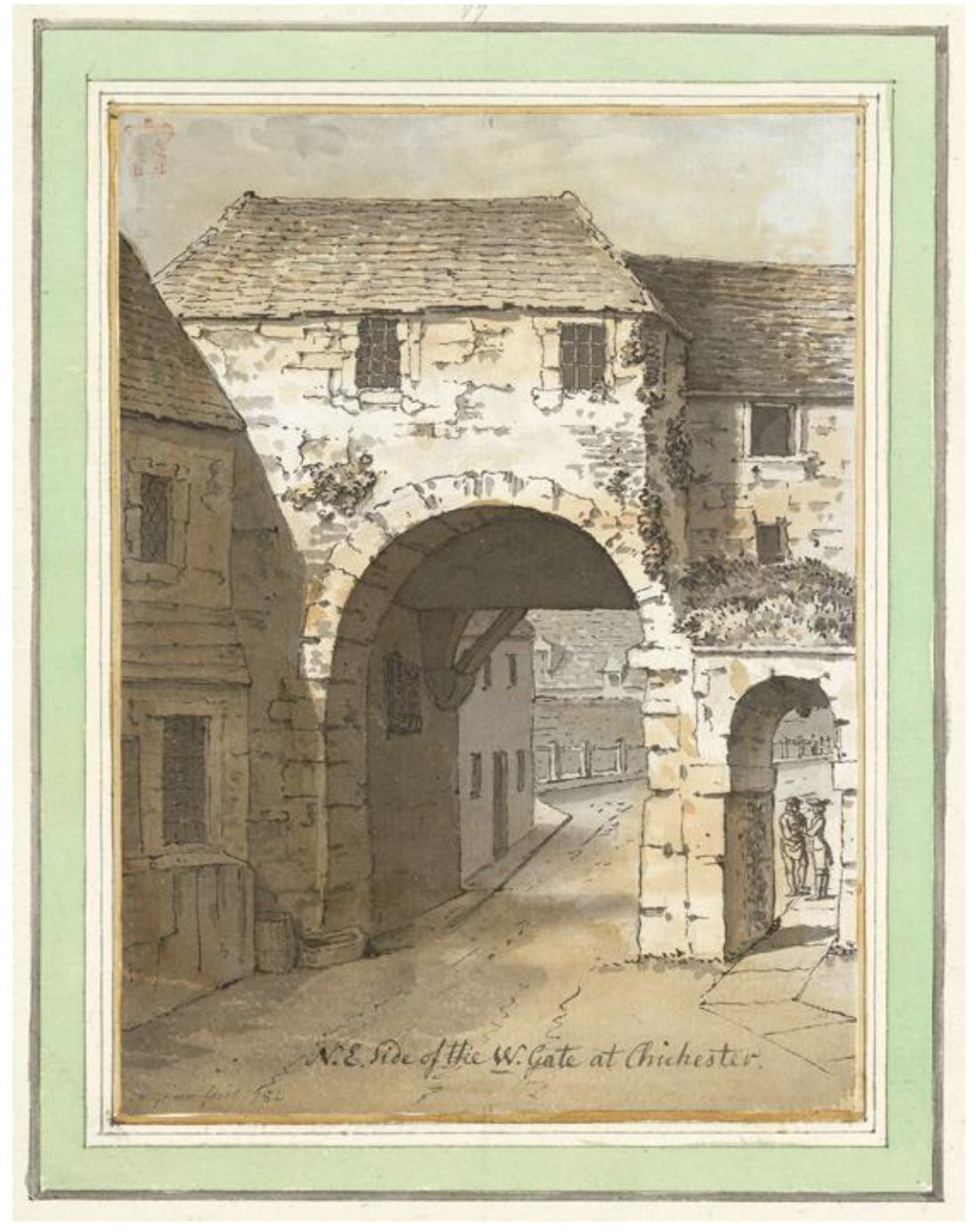
West Gate looking out from West Street, 1782. (Drawing by S.H. Grimm (c) British Library)
It has been queried whether this is the West Gate or the East Gate with the town gaol above it, but the building just outside the gate on the left looks remarkably like the White Horse Inn in the photograph on the next page. I am convinced that this is genuinely the West Gate.
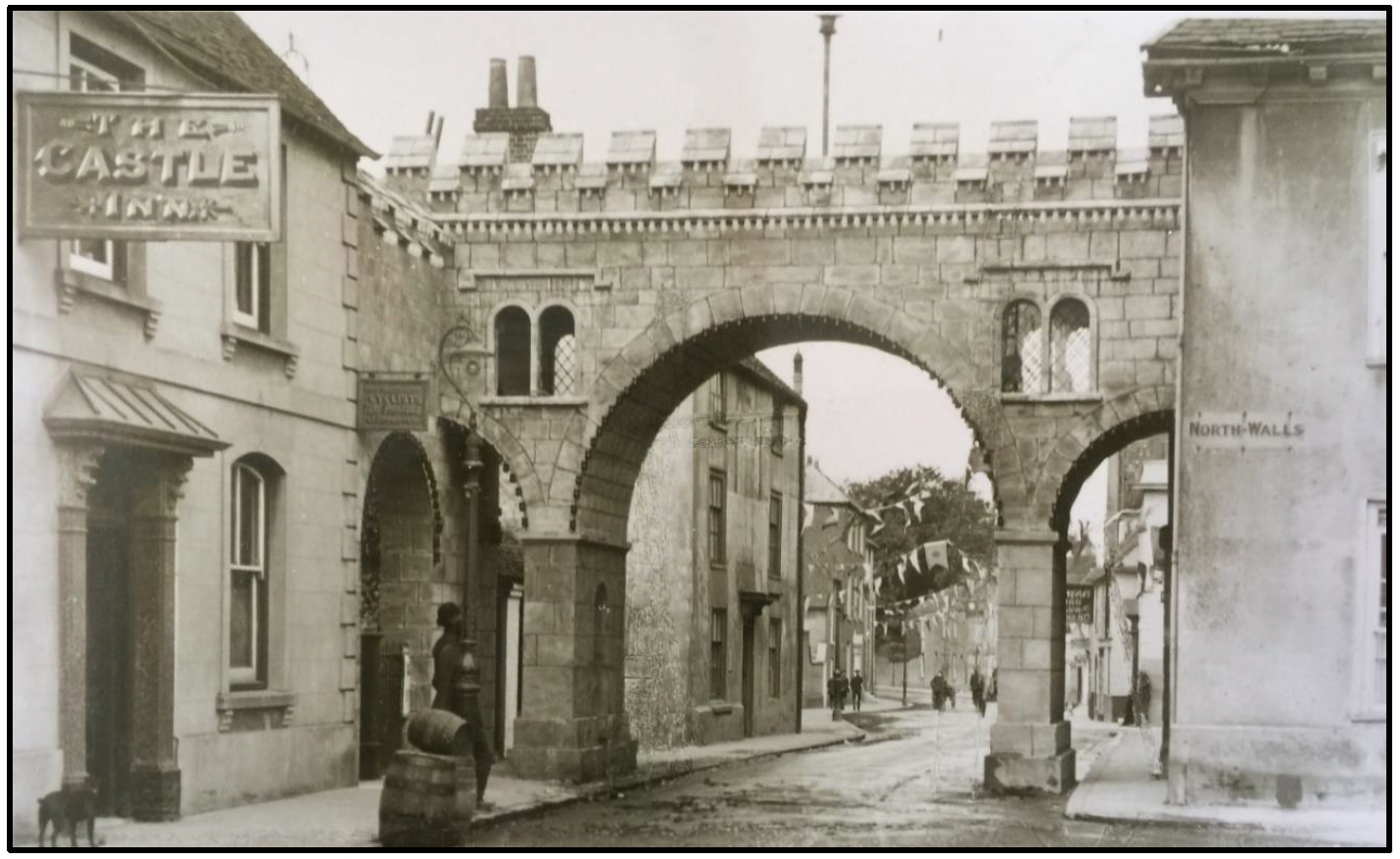
Photograph of the Commemorative Arch built in 1911 for the coronation of George V, on the site of the old West Gate, looking westwards out of the city.
This arch was built by John Ogburn Holt a builder, who lived at 4 Westgate. The Castle Inn is now called the Chichester Inn. The White Horse Inn outside the walls in Westgate, was demolished to build Westgate Fields Road.
Commemorative arches were also built at West Gate for:
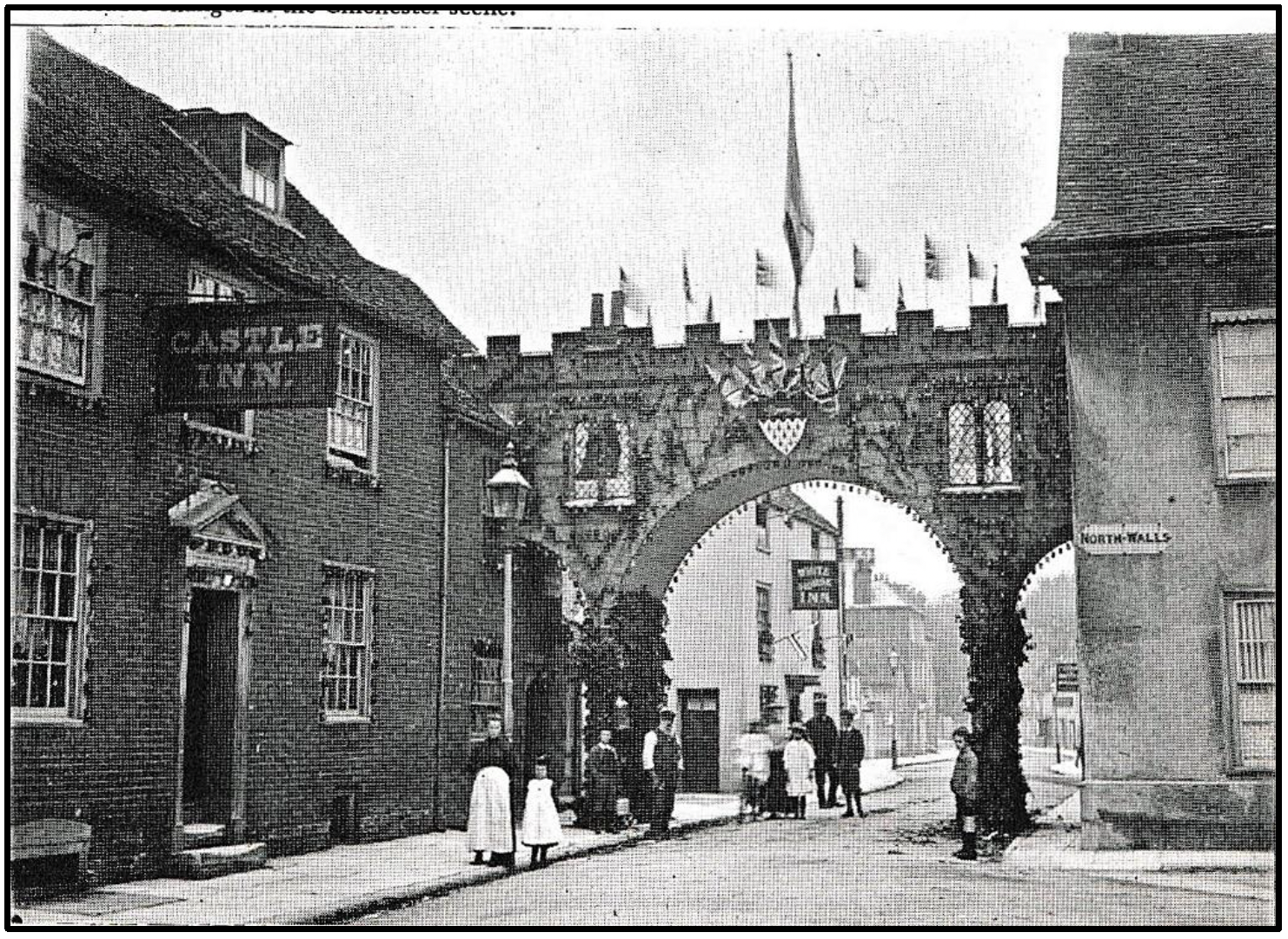
Victoria Jubilee commemorative arch 1897 (looking west)
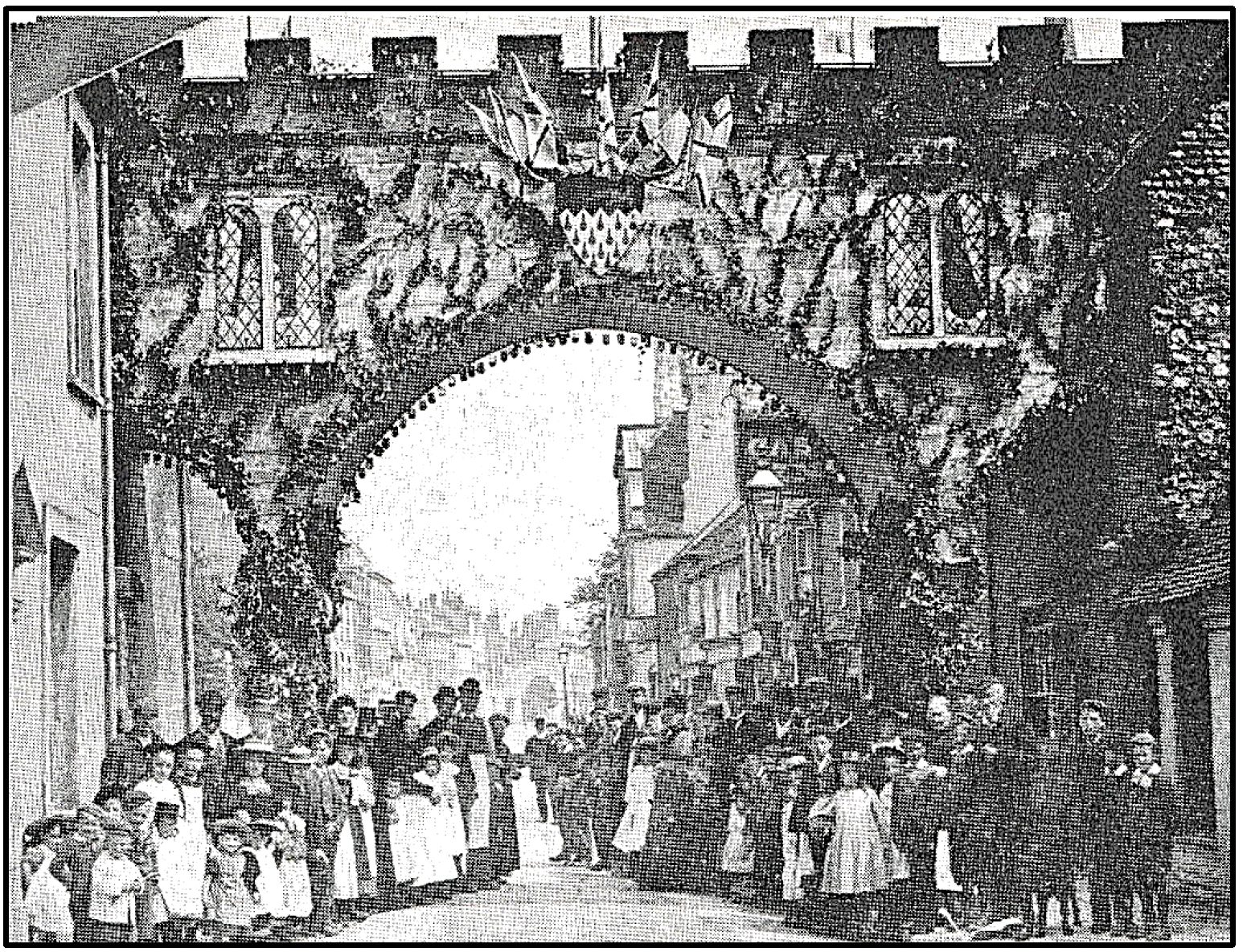
Coronation Edward VII commemorative arch 1902 (looking east)
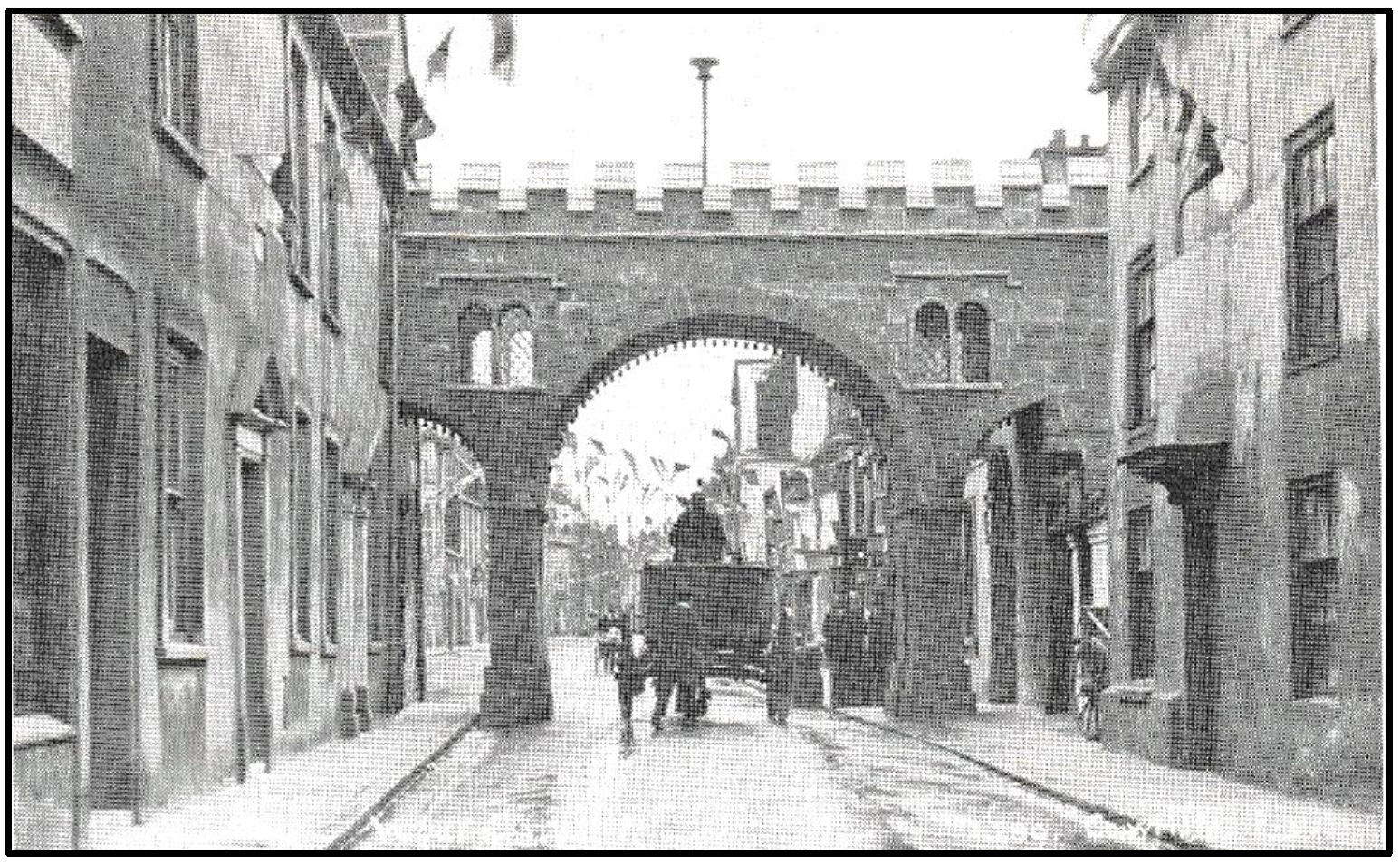
Another eastward view of the 1911 coronation arch, with the city watercart going into the city. The archways were beaded with coloured glass beehive-shaped lights. All the commemorative arches are of similar design.
“The growth of the city of Chichester is shown by its architecture. The medieval city was probably composed mainly of timber-framed buildings, and indeed, until the 17th century, when brick was employed, apart from a few stone houses, other methods or materials were little used. At the turn of the 18th century, however, there was a gradual change in the appearance of the town, and by the end of the century it had been almost entirely rebuilt. Except for the shopfronts and one or two alterations and replacements (due to fires) it has altered little since then. Architecturally the general character of the buildings is rather primitive, but there is some excellent work in the larger houses, the most noteworthy feature being the number of beautiful 18th-century doorways and their fanlights, and the surprising number, ingenuity of arrangement, and excellent detail of the bow-fronted windows in the main streets.
Outside the West Gate the houses are mostly of the 18th century, as the older suburb of St Sepulchre (St Bartholomew), dating from the 13th century, was burnt down during the siege of December 1642. The Westgate Brewery is to the north and The Tannery is on the south side of the road.
Except for the twin eastern suburb of St Pancras, other extensions of the city outside the walls are mainly modern developments and on the north side are largely occupied by institutions. To the north of the city the land was formerly woodland. The Broyle, which was an enclosed area of woodland stocked with deer or other beasts of the chase, belonged as forest land to the king, who appointed wardens of it. This forest land was surrounded by chaces and woods belonging in the 12th and 13th centuries to lords of adjoining manors such as Savary de Bohun, Geoffrey Falconer (the wood of Depemersh), the Abbot of Sées and the Archbishop of Canterbury. These chaces and woods were divided from the King’s Broyle by ditches, which may be represented by some of the entrenchments still to be found in this district.” [written in 1935].
Richard Brownfield 2025
Sources
- “The Gates”. Colin Hicks. January 2016
- The City of Chichester, Historical introduction in ‘A History of the County of Sussex’ Volume 3. ed L.F.Salzman (London 1935) pp82-90
- http://www.british-history.ac.uk/vch/sussex/vol3/pp82-90