Following extensive research by Dr Brownfield, here is a full description of the history of the Theological College, mostly taken from documents at the WSCC Record Office
The Story
The College was founded by William Otter in July 1838, the first such Diocesan College in England. The first Principal was Charles Marriott, of Oriel College, Oxford. He was a member of the Tractarian Society. The first donation for the college, of £50, was from W. E. Gladstone.
In 1884 the Vicars Hall was leased, and alterations were made to provide a lecture room and library.
From 1886, during Josiah Sanders Teulon’s time as principal, the college experienced a gradual decline in students. This was exacerbated in 1899, when he resigned, but retained his income as a resident canon. At a meeting of the college council, it was resolved to close the college. However, the vice-principal made a successful case for continuing and Herbert Rickard was appointed the new principal.
In 1903, a hostel in West Street was bought for £1000 by the college council, the balance being paid by the principal in memory of his wife. This was refitted and became the college headquarters. This hostel was sold in 1909, and the proceeds went towards the purchase of new headquarters at 52 Westgate the old Henty family house (now Mercers), next to the brewery, for £3500.
After closure due to the Great War, the college was formally re-opened on May 1st, 1919, by Bishop Charles Ridgeway (his last episcopal act) and was dedicated to St Richard of Chichester. A wooden church converted from an army hut and moved from Brighton was erected in the grounds to serve as a chapel.
In 1927 the Westgate building was enlarged by the addition of the Bishop Ridgeway Memorial Wing for a cost of £350.
In 1930 a lease was taken on 40 Westgate (now No. 28) for extra accommodation. In 1932 this was replaced by 46 West Street.
In 1935 the Ecclesiastical Commissioners acquired a large house at 3 Westgate with “beautiful gardens and playing fields” and leased it to the College for additional accommodation. Eighteen students and 2 members of staff lived there. There were 20 bedrooms, 4 WCs and 4 bathrooms. It was re-named Marriott House.
During World War II the college was forced to move temporarily to Cambridge and the buildings in Chichester were used by the military authorities. At the end of the war, the college buildings – apart from Marriott House (3 Westgate) – were sold for £9,000.
Marriott House, with a wing in the Bishop’s Palace, was used to house the re-opened college from 21st October 1946. It was described as having ‘giant rooms’ used as a common room, dining room, bar, and accommodation for 18 students and a member of staff.
In 1948 a claim against the War Department was finally settled for “dilapidations of the building, the gardens and playing fields during the use by the military during the war”. The College was however responsible for repair and redecoration of the exterior of the building, which were completed in 1949 at a cost of £334.6s. The College adopted St Bartholomew’s Church as their chapel, although some seats were still reserved for local residents.
In 1950 Number 5 Westgate (new road numbering that year) was leased from the Church commissioners for extra accommodation (Clergy House)
In 1954 major work was done at Marriott House to improve the kitchen and Dining Room.
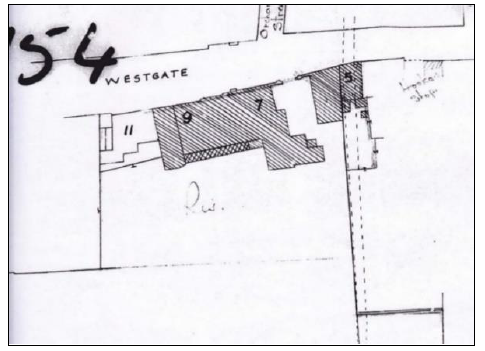
1954 Planning application Block Plan. This shows No. 7 before the dining room extension was built and includes the line of the River Lavant culvert, which Mr Farr found when digging in his garden at 1 The Courtyard.
In 1959 the principal reported at the General Meeting:
“A few years ago Dr Moorman (the principal at the time) took over the lease of the house adjoining Marriott House, 11 Westgate (Now 7+9). At the end of 1958 the tenants found other accommodation and plans are underway for adaptions to the house to provide accommodation for 8 or 9 students. This will bring into the centre of the College a number of students who have scattered through the town in our expansion.”
That year rent was paid by the College on numbers 5, 7, 9 and 11 Westgate. The plans for annexing and adapting number 11 were completed in 1961. Negotiations were commenced with the Ecclesiastical Commission, from whom the building was leased by Chichester Theology College Ltd. Ownership transferred the same year.
At this time there were plans for the creation of a ring road around the city. This would result in the loss of a strip of land to the east of Marriott House, including the empty White Horse Inn with its yard and houses behind no. 5 Westgate, plus the garages and land beneath the city walls. A notice to quit number 5 was served in 1964 and compensation of £5,800 was accepted. In the same year there appears to have been a problem with the wall between the end of college land and Mrs Frith’s Garden (at no. 15). A later note mentions a fallen tree. It was agreed to share the expense of repairs equally.
In May 1965 the new block on the playing field, later called Gillett House, was finally opened, although there appears to have been considerable trouble with delays, water penetration and other necessary repairs. This new ‘Brutalist’ accommodation block was built by ABK architects (Ahrends, Burton and Koralek) and is now listed Grade II. It is now known as Marriott Lodge but known by the students as ‘Colditz’. Number 13 Westgate, which had been rented by a clergyman was offered to the College, but the price was considered too high. By this time the College appears to have been getting into some financial difficulty but plans still continued for the construction of a new accommodation block and the sale of the old Marriott House.
In 1987, nos. 7, 9 and 11 Westgate were sold to the Abbey Building Association (which became the Abbey National Building Society) and the Theological College eventually closed in 1994.
Life as a Student
Taken from Student Days 1957-1959 by John H Richardson, pub. Chichester History No 23 (2007)
Fifty years have passed since I became a student at Chichester Theological College. I began my training for ordination at Durham University. After graduation, students usually went on to a Theological College, so I applied during the summer of 1956. I remember arriving at the old, mainly wooden, rat-infested railway station. The College was at the end of Westgate, opposite Orchard Street. I was interviewed by Dr John Moorman, the Principal. Having gained a place, I took up residence in October 1957. The principal by that time was Canon Cheslyn Jones; he was also Canon Treasurer of the Cathedral. Canon Jones was an expert on St John’s Gospel, but also something of an eccentric bachelor.
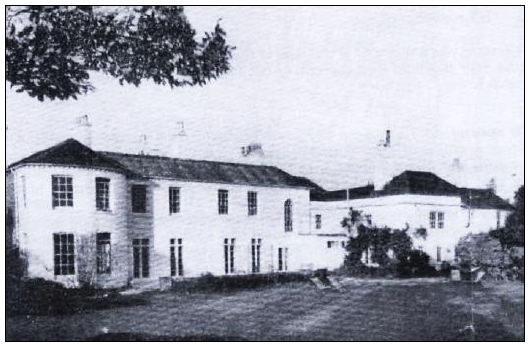
Marriott House from the garden (current Georgian Priory)
The College, the oldest of its kind in England, was founded in 1839. The College moved after the war to the corner of Westgate and (what is now, but at the time did not exist) the Avenue de Chartres. Its buildings included parts of the Bishop’s Palace and a late eighteenth century house, (3 Westgate – called Marriott House when the College owned it).
The main lecture room, library, dining hall, common room and Principal’s flat, plus several student rooms, were all in Marriott House. My first room was, ‘30’ directly over the main door. Later I had a top room at the back of 18 Westgate (Now 15 Westgate), the home of Mrs Frith, a Canon’s widow, together with another student and the tutor. The bypass must have been very quiet late at night in those days, because on foggy nights the Nab lighthouse foghorn could be heard. Other students were housed in a cottage that was later demolished to make way for the Avenue de Chartres (then no 2 Westgate).
Lectures, tutorials and study followed after breakfast at 8.30am. The afternoons were filled with a variety of activities involving work or leisure pursuits. Evensong was at 5.30pm. We attended Cathedral Evensong on Tuesdays and Thursdays, the College choir often singing the service on Thursdays. Study and tutorials followed dinner. Some evenings were taken up by visiting speakers, who covered a whole range of topics. I remember hearing such people as Dr Francis Steer, the County Archivist; Dr Fleming, the Bishop of Portsmouth who had been on an Antarctic expedition; and the journalist who wrote the Peter Simple column in the Daily Telegraph. The day ended with Compline in Chapel towards 10pm.
Personal discipline and spiritual development were at the heart of this regular routine. Practical parish experience was gained through taking services in surrounding parishes. I went to Apuldram on Easter Monday; West Wittering for Harvest Festival – a daunting experience as Norman Shelley the actor read the lessons – and to St Bartholomew’s which was an even more difficult assignment. A student took the service whilst I preached to the congregation, which consisted of one charming elderly lady, another who slept soundly, and a man who was not quite with it. Who was I to address? Some afternoons were free from these parish duties. Croquet was popular on the lawn during the summer – a test of temper control. Mallets were known to have been broken. Cricket was played on the College field where the Tollhouse flats now stand. Walks were taken via Brandy Hole Lane or down to the harbour past St Bartholomew’s. Cows grazed in the meadows as we walked to the railway footbridge and over the bypass.
The mid to late 1950s were a time of church expansion and optimism. The College increased in size to around fifty students, so sadly we had to move from the Bishop’s Chapel to St Bartholomew’s for our worship, the Chapel being too small.
In 1985 The college moved again to a new building known then as Gillett House on the site of what is now Marriott House Nursing Home. In addition, a rather austere accommodation block was built in the grounds. This fortress-like building has windows high up and at an angle, pointing skywards (the Principal thought students should not be distracted but look upwards!); now known as Marriott Lodge, this has also been incorporated in the subsequent nursing home.
By 1984, sadly the shortage of ordinands, the cost of residential accommodation, and the need to concentrate on larger academic institutions meant the closure of Chichester Theological. College Peter Atkinson, formerly Chancellor of Chichester Cathedral, and later the Dean of Worcester was the last Principal of the College before its closure.”
Historical Timeline 1839-1994
Timeline of Chichester Theological College from WSRO’s on-line catalogue. Further records are located under Cap.V/9/1-3. Reference to these has been made under the relevant class.
1839: College founded by Henry (later Cardinal) Manning, Rector of Woolavington, Bishop Otter, and George Chandler, Dean of Chichester. The first Principal is Charles Marriott (to March 1841) whose handwriting begins thefirst logbook. (IX/I/I).
1841: Charles Marriott resigns as principal due to ill health.
1842: Henry Browne becomes principal (to November 1845).
1846: Bishop Freeman appointed principal in March. The college having suspended its operations since Henry Brown’s resignation the previous November.
1854: Charles Anthony Swainson succeeds as principal.
1870: Arthur Rawson Ashwell succeeds as principal and the number of students soon increases. Some of his comments on the students are preserved in this register, continued by the next principal (Ep/IX/1/6). Canon Aswell started a guild of the Holy Road, later renamed the Guild of St faith, whose minute book survives (Ep/IX/7/5/2).
1879: On the death of canon Ashwell, William Awdry is appointed principal. The college continues to flourish under him.
1884: Alterations made to the Vicar’s Hall – used by the college as a lecture room and library (see Ep/IX/10/1/1 & 2).
1886: Josiah Sanders Toulon succeeds as principal. The number of students gradually declines. 1889: College 50th jubilee celebrations.
1899: Canon Toulon resigns the principalship but retains his residentiary canonry which creates financial problems for the college. At a meeting of the college council, it is resolved to meet the Vice-principal with a view to winding up the college. However, the vice-principal makes a successful case for continuing and Herbert Rickard is appointed the new principal
1903: The hostel in West Street is bought for £1000 by the college council, the balance being paid by the principal in memory of his wife. This was refitted and became the college headquarters.
1914-18: During the latter part of the war the college was closed.
1918: Prebendary Rickard accepts the living of Amberley and Herman Leonard Pass takes his place as principal
1919: The hostel is sold, and the proceeds go towards the purchase of new headquarters in Westgate for £3500. On May 1st. the college is formally re-opened by Bishop Ridgeway (his last episcopal act) and dedicated to St. Richard. An army hut, previously used as a church of wounded soldiers in Brighton (See Ep/IX/10/3/1-3) is re-erected by the new headquarters to serve as a chapel.
1920: The college acquires a three-year lease of a house opposite the college buildings and equips it as a hostel. The principal is appointed vicar of S. Bartholomew’s – the parish in which the college stands – and the vicarage is also subsequently used as a hostel.
1922: First number of The Cicestrian, the college magazine
1925: Chichester Theological College Ltd. is incorporated. (For the minute books 1926-67, see Ep/IX/2/1 & 2.) Important Eastern prelates visit Chichester.
1927: The buildings in Westgate enlarged by the addition of the Bishop Ridgeway Memorial Wing (see Ep/IX/10/4/1).
1929: The college celebrates its 90th anniversary.
1930: The college acquires a short lease on 18 Westgate to provide extra accommodation.
1932: Charles Scott Gillett succeeds as principal.
1934: The tenancy of 18 Westgate is relinquished, being replaced by 46 West Street
1935: The Ecclesiastical Commissioners buy the house at 3 Westgate, which is leased to the college and named `Marriott House’. The vicarage and all but a few rooms hired as lodgings are given up.
1939: The college’s centenary is celebrated
1941: The college is forced to move temporarily to Cambridge. About this time the buildings in Chichester are in use by the military authorities.
1942: The principal is invited to assume temporarily the duties of principal of the Edinburgh Theological College. Canon Gillett accepts, taking with him the remaining Chichester students from Cambridge.
1945: The college buildings are sold, with the exception of Marriott House.
1946: The college re-opens on 21st October at Marriott House with John Richard Humpidge Moorman as principal, Canon Gillett having resigned due to failing health. The new principal’s journal is among the records (Ep/IX/1/8).
1956: Cheslyn Peter Montague Jones succeeds as principal (to 1969).
1959: The parish of S. Bartholomew is united with S. Paul’s and the former parish church (of S. Bartholomew) becomes the college chapel.
1968: On September 2nd the Feast of the New Guinea martyrs is celebrated and a memorial to Vivian Redlich – a sculpture of an owl, by Darsie Rawlins – is unveiled.
1970: Alan Bassindale Wilkinson succeeds as principal (to 1974).
1974: The Archbishop of Canterbury visits the college.
1975: Robert John Halliburton succeeds as principal
1982: John William Hind succeeds as principal.
1983: The Bishop of Chichester lays the foundation stone of the new college building
1985: The new building, Gillett House, is opened by the Archbishop of Canterbury. 3 Westgate is sold (26th May) to Abbey Building association.
1989: 150th anniversary celebrations
1991: Peter Gordon Atkinson succeeds as principal
1994: College closes.
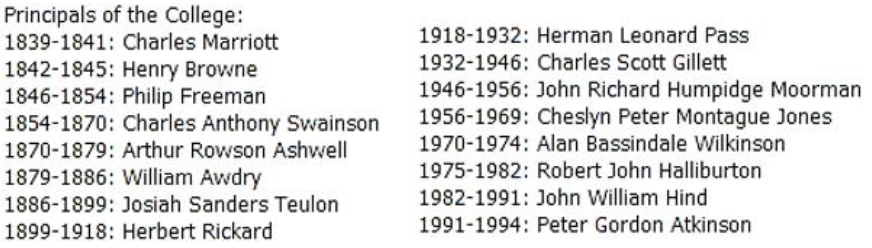
Richard Brownfield 2025
Sources
- http://en.wikipedia.org/wiki/Charles_Marriott_%28Tractarian%29 WSRO Ep IX/10/5/2
- Wikipedia http://en.wikipedia.org/wiki/Chichester_Theological_College
- WSRO Microfiche
- Chichester Observer September 7, 1989
- Minutes of CTC Ltd General Meeting
- WSRO Online Catalogue EP/1X